Cicero Would Have Loved Twitter, and It Would Have Destroyed Him
The first Roman to understand that being right and being liked are different jobs, and that you can lose your head trying to do both at once.
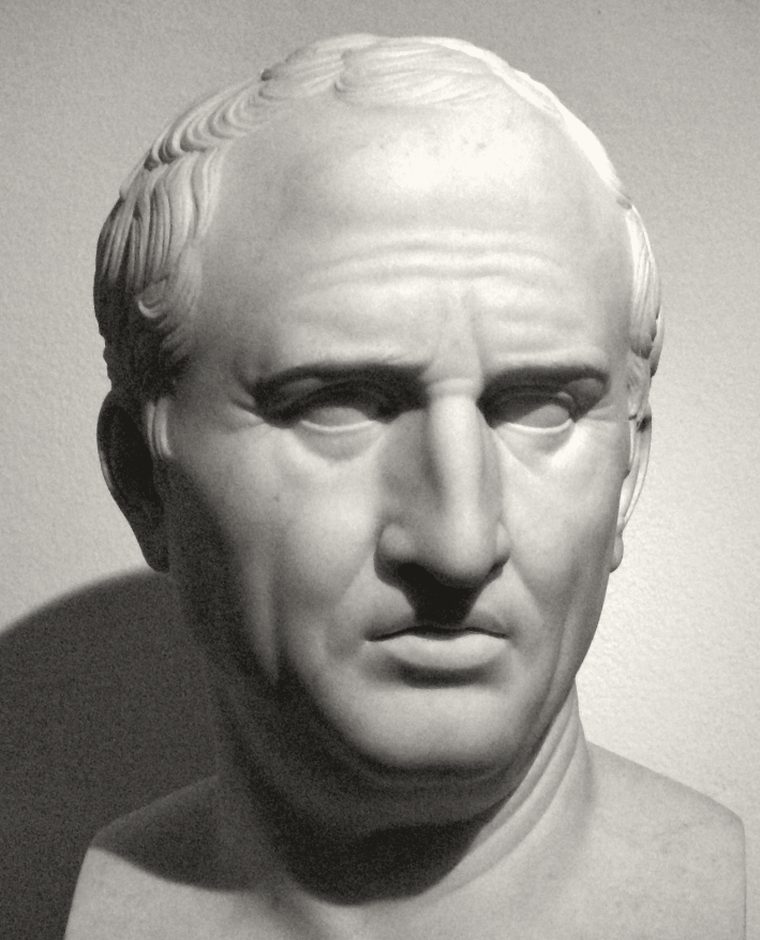
There is a kind of person who walks into the room already mid-argument with someone who is not there. Cicero was the founding member. We have the receipts: about nine hundred of his letters survive, and a startling number of them are him narrating, to his friend Atticus, exactly how badly he just owned someone at a dinner he is still technically attending. He would have understood the timeline immediately, the way a fish understands water. He would not have understood why anyone logs off.
Consider the night of November 8, 63 BC. Cicero is consul. He has intelligence that the bankrupt aristocrat Catiline is planning to murder him and burn the city. A lesser man calls the guard. Cicero calls the Senate into session, waits for Catiline to sit down, and then opens his mouth on the single most quoted subtweet in the history of public life: Quo usque tandem abutere, Catilina, patientia nostra? ("How long, Catiline, will you go on abusing our patience?") Notice the move. He does not say you are a threat to the Republic. He performs his own exhaustion at having to keep dealing with you, which is a different and far more devastating thing. He makes the whole Senate the audience to his fatigue. Everyone in the room becomes a follower watching a quote-tweet land. Catiline, who came to give a speech, sits there getting ratioed by a sitting consul in real time, and walks out of the city that night.
This is the thing about Cicero that the timeline would have loved and then killed: the man genuinely could win a room with words alone. He talked Rome out of a coup. He did it without an army, which is the part he could never stop reminding people about, in the same way a person who ran one marathon will find a way to mention it during a conversation about almost anything. He coined a slogan for his own consulship, cedant arma togae, let weapons yield to the toga, and then put it in a poem about himself, and then quoted the poem in his speeches, and the poem was so relentlessly self-congratulatory that even his allies begged him to stop reading it aloud. He had the engagement brain. The dunk was never enough; the dunk had to be archived, footnoted, and recirculated.
The quote-tweet that ate a decade
What undid him was not a lack of talent. It was that the platform rewards the exact instinct that ruins you. Cicero could not let a thing go. When his enemy Clodius, a man who had desecrated a religious festival by sneaking into it in a dress, came up for trial, Cicero blew up his own alibi on the stand, apparently because he could not stand to let Clodius enjoy getting away with it quietly. Clodius got off, became a tribune, and immediately passed a law that sent Cicero into exile, his houses torn down, a shrine to Liberty built spitefully on the rubble of his mansion on the Palatine. Cicero spent the exile writing letters about how unfairly he was being treated and how everyone had abandoned him, which is to say he spent it the way anyone spends a bad week of being the main character: refreshing, drafting, refreshing.
And here is where the comedy turns, because the satirist's job is to follow the joke all the way down to the place it stops being funny. The reply guy who wins the platform does not win the war. After Caesar's assassination, Cicero made his last and best bet: he picked the young Octavian as an ally and turned the full battery of his rhetoric on Mark Antony in a series of speeches he proudly called the Philippics, after Demosthenes, because even his hit pieces had to cite their sources. They are magnificent. They are also a string of public posts calling the most dangerous man in Italy a drunk, a forger, and a male prostitute, by name, in the senate house, with no army of his own.
Antony read the posts.
When the Second Triumvirate carved up the empire, Antony's single non-negotiable demand was Cicero's name on the proscription list. The soldiers caught him near the coast, half-fleeing, half-not, the way you keep a tab open you mean to close. Plutarch says he leaned his head out of the litter and offered his neck, an old man who had talked his way into and out of everything and finally met a sentence he could not finish. They cut off his head and his hands, the hands that wrote the Philippics, and nailed them to the Rostra, the public speaking platform in the Forum, the literal place from which he had posted. Antony's wife Fulvia is said to have pulled the tongue out and stabbed it with a hairpin. It is the most on-the-nose thing the ancient world ever did. They turned the comment section into a gallows and hung the account from it.
We tell ourselves the platform is new. It is not. The platform is just the Forum with the friction removed, and the friction was the only thing protecting Cicero from himself. He needed the slow walk home to cool down, the day's delay before a letter reached Atticus, the physical effort of carving an insult into the public record. Take all of that away, hand him a device that posts at the speed of resentment, and you do not get more Cicero. You get the proscription faster. The lesson of the greatest orator in Roman history is not that the right words win. It is that the man who cannot stop saying the right words, to the wrong people, at the worst possible moment, ends up as a cautionary headline nailed to the spot where he was the most himself.
He would have loved it here. That is the tragedy. He would have been so good at it, and it would have taken him in a year.